Are you looking for an open-source tool to efficiently extract web content in a RAG workflow or an AI data pipeline? Firecrawl and Crawl4AI are two must-have candidates. These frameworks are designed not for SEO or competitive analysis, but for large-scale text data ingestion, compatible with LLM-first use cases.
Firecrawl, written in TypeScript, offers a fast, modular crawler that is easy to connect to APIs like LangChain. Crawl4AI, developed in Python, focuses on scalability via Ray or Spark and positions itself as a RAG-ready framework for data engineers.
Their comparison is natural: both are self-hosted, open-source, designed for developers, and integrable into modern document processing stacks.
An open-source philosophy, but with very distinct approaches
Under their permissive licenses (MIT for Firecrawl, Apache 2.0 for Crawl4AI), these tools embody two visions:
Firecrawl prioritizes raw performance, quick deployment, and simplicity of API calls;
Crawl4AI bets on Python extensibility, fine control over parsing logic, and seamless integration with current AI frameworks.
In this duel, everything depends on your preferred programming language, infrastructure constraints, and the level of customization required.
TL;DR : Firecrawl and Crawl4AI are two open-source frameworks designed for large-scale web exploration. The former stands out for its speed and multi-language support, while the latter focuses on fine integration with Python, LangChain, and Ray. This duel is aimed at developers looking for a self-hosted, modular tool tailored for RAG pipelines.
Firecrawl: the multi-language rocket
A fast crawler, written in TypeScript, designed for performance
Firecrawl is a modern web scraping framework designed for speed. Written in TypeScript, it can be self-hosted or called via a SaaS API, depending on your needs. Its main asset: ultra-low latency, thanks to an architecture built for massive crawls, even on modest machines.
The tool can analyze an entire page, follow redirects, ignore robots.txt tags, and generate a complete HTML, text, or structured JSON rendering in a single call. Firecrawl is therefore particularly suited for projects that require rapid indexing, such as AI assistants or high-volume internal engines.
Tested on RAG datasets, Firecrawl has shown crawling performance up to 10× faster than some Python alternatives (Firecrawl, 2024 – firecrawl.dev).
Firecrawl shines with its unique API capable of returning multiple formats, making it an excellent entry source for LLM pipelines. It natively integrates with LangChain, particularly through an official connector, which facilitates the creation of autonomous agents tasked with fetching information from the web.
Other strengths:
SSR rendering (complete rendered HTML) compatible with dynamic JS;
Automatic management of network errors (timeouts, refusals, 403);
Native support for multiple languages (UTF-8, UTF-16, etc.).
However, Firecrawl is not perfect. Its TypeScript backend, while efficient, may deter teams unfamiliar with Node.js. Moreover, advanced debugging is less documented, especially in cases of non-trivial network errors or sites protected by anti-bot measures.
Another point of concern: Firecrawl uses third-party proxies to bypass certain blocks, which may raise privacy issues in sensitive GDPR contexts.
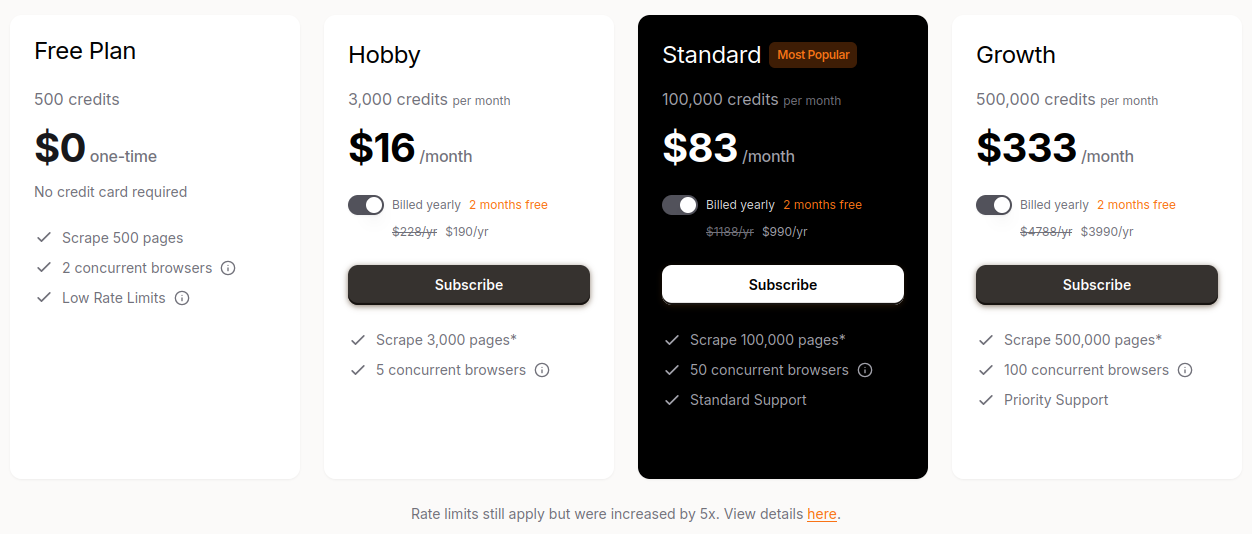
Pricing
Crawl4AI: Python-focused scalability
A native Python tool with Ray & Spark for scale-out
Crawl4AI is an open-source framework written in Python, designed from the ground up for integration into complex AI workflows. While Firecrawl prioritizes raw speed, Crawl4AI offers an architecture designed for distributed orchestration, particularly via Ray or Apache Spark.
This choice makes it ideal for pipelines where one wishes to crawl thousands of pages while applying fine parsing, cleaning, and semantic enrichment rules.
Crawl4AI easily integrates with distributed systems, allowing the parallel processing of millions of documents without bottlenecks.
Strengths: fine customization, RAG-ready integration, NLP-first
Crawl4AI exposes a flexible Python interface, allowing users to:
Define their own extractors (HTML, JSON, CSS, XPath…);
Directly connect the framework to vector engines or orchestrators like LangChain, LlamaIndex, or Haystack.
Its main advantage: the logic is customizable at all levels, making it particularly suitable for production RAG projects, especially in cloud environments like Azure or AWS.
Limitations: less mature, requires tuning
However, Crawl4AI still suffers from a relative lack of maturity. Its documentation remains rudimentary, its installation requires some adjustments, and the default performance can vary depending on the cluster used.
Another weak point: to fully benefit from its distributed capabilities, one must already master technologies like Ray, Spark, or message queues (Kafka, Redis). It is therefore not the most plug-and-play tool for a junior team or a startup in exploration phase.
Comparison table: Firecrawl vs Crawl4AI
Criteria: performance, scalability, ease of use, community
Criterion
Firecrawl
Crawl4AI
Main language
TypeScript
Python
Installation
Simple (Docker, NPM, or SaaS API)
Medium (Python setup + dependencies)
Native scalability
Limited (local threading or via proxy pooling)
Advanced (Ray, Spark, multiprocessing)
Customization
Medium (API options + TS config)
High (modular Python code, custom hooks)
LangChain integration
Native API + official connectors
Native via Python SDK and RAG adapters
Output formats
JSON, HTML, plain text
JSON, HTML, enriched text (with integrated NLP)
JS / dynamic DOM support
Yes (rendered headless browser)
Partial (via Playwright or Selenium)
Raw performance
Excellent (response time <1s/page)
Average (depending on cluster or machine)
Community / docs
Active, clear docs, open-source AGPL
More limited, minimal docs, open-source Apache 2.0
License
AGPL (self-hosted)
Apache 2.0
Quick analysis
🏁 Firecrawl is ideal if you are looking for maximum speed, a simple API, and ready-to-use rendering for AI ingestion.
⚙️ Crawl4AI stands out for its customization flexibility, particularly in Python, and its ability to scale horizontally.
The choice therefore depends mainly on your technical level, your AI integration needs, and the expected load. Firecrawl is more immediate; Crawl4AI is more modular.
Which tool to choose based on your use case?
For fast, low-cost, plug-and-play scraping
Do you need to extract web content quickly, with minimal configuration? Firecrawl is probably the best choice. Its simplicity of call via an HTTP API, its complete dynamic rendering, and its direct integration with LangChain or Zapier make it an excellent tool for startups, product teams, or proof-of-concept projects.
Moreover, Firecrawl can operate without heavy infrastructure: a Docker container is sufficient, or you can even use their SaaS API to test without installing anything. Perfect for getting started quickly.
Firecrawl allows crawling about a hundred pages in under a minute on a simple VPS server (Firecrawl, 2024).
For fine integration into a Python RAG pipeline
If your stack is Python-oriented, you handle large volumes, or you seek to enrich each document with NLP pre-processing, then Crawl4AI becomes very relevant.
Its natural integration with frameworks like Ray or Spark makes it more suited for production RAG pipelines, especially when extracting, enriching, vectorizing, and then storing documents at scale. It also allows you to insert your own parsers or post-process through simple Python functions.
The duel between Firecrawl and Crawl4AI well illustrates the two main approaches to open-source web scraping in the age of generative AI: on one side, Firecrawl offers an ultra-fast solution that is easy to integrate via a single API; on the other, Crawl4AI provides a modular toolkit in Python, ideal for scalable and customizable pipelines.
If you are looking for a performant, easy-to-deploy tool, Firecrawl is an excellent choice. Conversely, if your priority is flexibility and deep integration into your RAG stack, Crawl4AI will be more suitable.
In any case, this Firecrawl vs. Crawl4AI comparison shows that it is no longer necessary to choose between efficiency and freedom. Open-source now offers solid alternatives, suited to all levels of technical requirements.
👉 And you, in your next RAG project, will you choose the TypeScript rocket or Python scalability?
If you are still unsure or need specific support, our team is here to help
Want to go further?
This topic is part of our Generative AI for Developers course. Browse the full programme, or get it by email.
Share with
Romain DE LA SOUCHÈRE
Tech Lead, CTO AXI Technologies
Expert Data Engineering et Cloud, Romain affiche plus de 11 ans d'expérience, dont plusieurs années comme Lead Developer sur des solutions Smart Building haute performance. Il y a conçu et mis en production des moteurs de traitement capables d'absorber des centaines de milliers de données de capteurs par minute, ainsi que des bases clusterisées gérant plus de 10 millions de données dynamiques. Certifié Microsoft Azure DevOps Engineer Expert, il maîtrise aussi bien le développement back-end (Python, C#) que le DevOps (Docker, Kubernetes, Terraform) et les agents LLM. Formateur en Python, cloud, DevOps et IA générative appliquée, il forme avec une obsession : Amener chaque apprenant à concevoir et déployer des architectures réellement scalables en production.