Retrieval-Augmented Generation (RAG) is set to become the essential solution for deploying reliable generative AI systems in enterprises by 2025. By combining the power of LLMs with up-to-date and verified data, RAG reduces hallucinations, ensures regulatory compliance, and provides accurate responses. Here’s how to master this technology.
What is Retrieval-Augmented Generation?
RAG is a hybrid framework that integrates a search mechanism (vector database, semantic engine) with a generative model (like GPT-5 or Gemini). Unlike traditional LLMs, it does not rely solely on pre-trained knowledge but enriches its responses with externally retrieved data in real-time (Squirro, 2025).
-> Embedder: the lexical embedding model (example: OpenAI Embeddings) is used to transform data into vector representations. The embeddings created capture the semantic relationships between words, improving the accuracy of searches and contextual analyses.
-> Vector Stores: databases designed to handle data in vector form, thus facilitating advanced semantic search. These systems, such as Chroma and Milvus, are specifically optimized to interpret relationships and similarities between sets of vector data. They ensure that the most relevant and contextual information is accessible to enrich the responses generated by AI models.
-> LLM: generative model contextualized by the search results.
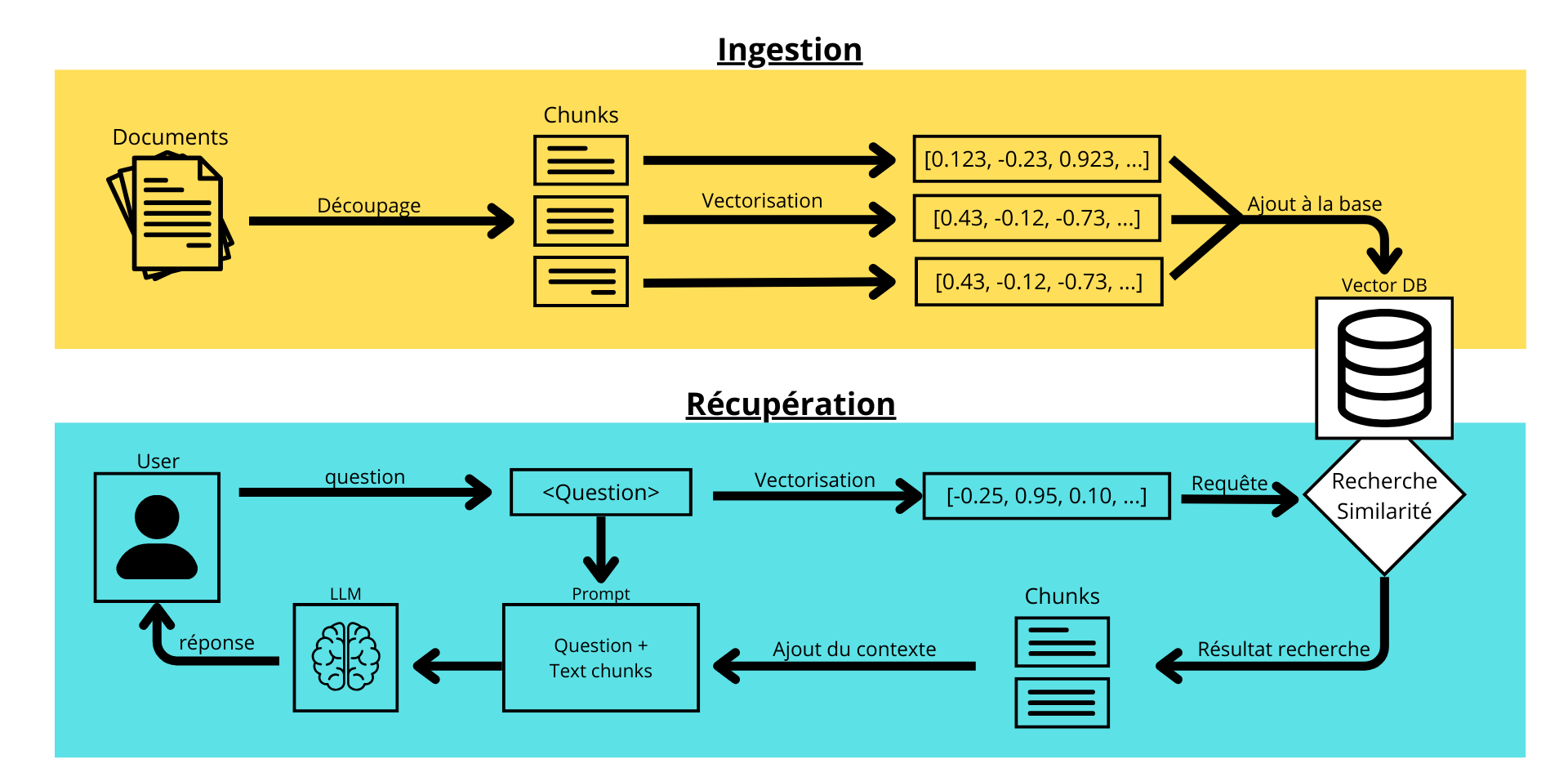
To better understand how RAG works, here is a step-by-step explanation illustrating the journey of the data, from its ingestion to the generation of an enriched response for the user:
Ingestion phase
The first step is to prepare the knowledge base:
Source documents: The process begins with raw documents (PDF, text, web pages, etc.)
Chunking: Documents are segmented into optimally sized fragments, generally 200-500 tokens, to maintain semantic coherence.
Vectorization: Each chunk is transformed into a numerical vector via an embedding model.
Storage: Vectors are indexed in a vector database (Vector DB) to allow for similarity search.
Retrieval phase
When a user query is made, the system activates the augmented generation process:
User question: The user poses their question to the system.
Query vectorization: The question is converted into a vector within the same semantic space as the documents.
Similarity search: The system queries the vector database to find the most relevant chunks.
Prompt enrichment: The retrieved chunks are added as context to the original question.
LLM generation: The language model produces a response based on the provided context and the question.
Final response: The user receives a factual and contextualized answer.
This architecture ensures that the responses are grounded in reliable sources while benefiting from the natural generation capabilities of LLMs.
If you are still unsure or need specific support, our team is here to help
New variants of RAG
In 2025, several innovative variants of RAG have emerged, each addressing specific needs and offering distinct advantages. Here’s an overview of these variations:
Self-RAG: This variant is designed to reduce interpretation errors. It incorporates an automatic verification system that corrects the model's hallucinations by evaluating the reliability of the sources used. Thus, it ensures increased accuracy of the information provided.
GraphRAG: Adapted for searches involving complex relationships, GraphRAG utilizes graph data structures to better contextualize information. By analyzing the interconnections between different elements, it offers a deeper and more refined understanding of the subject matter.
Golden-Retriever: This variant emphasizes the priority management of essential data. By enhancing compliance with GDPR standards, it ensures better protection of critical information while optimizing its use to produce relevant responses.
CAG: The Cache-Augmented Generation (CAG) is an innovative approach aimed at optimizing the speed and reliability of language models, particularly for tasks requiring extensive knowledge. Unlike RAG, which performs dynamic searches in an external database for each query, CAG preloads the entire relevant knowledge corpus directly into the model's expanded context window before any user interaction.
SuperRAG 2.0: Designed for multilingual environments and enterprises handling large volumes of data, SuperRAG 2.0 offers improved scalability. Its ability to efficiently process data in different languages makes it indispensable for organizations with diverse needs.
Each of these RAG variants contributes to enriching the ecosystem of generative AI systems in enterprises, addressing specific concerns while providing advanced features.
Choosing your vector database
Choosing a vector database is a strategic step in designing an effective RAG system. First, analyze the nature of your data (text, images, multimodality), the volume to be indexed, the frequency of updates, latency requirements, expected scalability, and integration needs with your technical stack. Dedicated vector databases, like Pinecone, Milvus, or Qdrant, generally offer superior performance for large-scale similarity searches, with optimized index management and advanced features (filtering, fine metadata management, replication). Solutions like Chroma are appreciated for their ease of integration and compatibility with modern LLM frameworks, while Weaviate stands out for its capabilities in managing knowledge graphs and extension plugins. Alongside these specialized solutions, there are general-purpose databases (PostgreSQL, Elasticsearch, Redis) enhanced with vector extensions, relevant for teams wishing to leverage their existing infrastructure (LeMondeInformatique, 2024).
In 2025, the main market choices include:
Pinecone (SaaS, high scalability, low latency, automated management)
Milvus (open source, very efficient on large volumes, suitable for real-time)
Qdrant (open source, flexible API, very good performance/features ratio)
Chroma (open source, ideal for prototyping and rapid integration with LangChain and LlamaIndex)
Weaviate (open source, native management of schemas and metadata, extensible via plugins)
FAISS (Facebook library, widely used for image and similarity search but requires additional orchestration for production)
LanceDB, Marqo, Vespa (emerging solutions, each with specific advantages depending on use cases)
The final choice should be based on your use cases: Pinecone and Milvus are suitable for applications requiring very high scalability and low latency, Qdrant and Chroma are perfect for rapid and flexible deployments, while Weaviate excels for advanced knowledge graph and metadata management needs.
Conclusion
By exploring the different components and variants of RAG, it is clear that this approach offers vast possibilities suited to varied needs. The ability to combine the power of generative language models with external data significantly enriches the quality of the responses provided. Each step, from data ingestion to final generation, is designed to maximize efficiency and relevance, thereby ensuring an improved user experience.
Strategic choice of technologies
The success of a RAG pipeline relies on the judicious selection of its technical components, notably the vector database. As we have seen, several options are available to developers, each with its advantages and disadvantages. The key is to choose a solution that aligns with the specific needs of the organization in terms of data volume, latency, scalability, and ease of integration.
Future perspectives
With the rapid evolution of technologies related to RAG, we can expect continuous improvements in terms of accuracy and processing capabilities. New variants, such as Self-RAG and SuperRAG 2.0, show how this technology can be adapted to meet the specific challenges faced by modern enterprises. Implementing such solutions requires a deep understanding of needs and an anticipation of future technological developments.
Practical application
For businesses, integrating a RAG pipeline can transform the way they access and utilize information. Whether to enhance customer service, optimize internal processes, or develop new products, the potential applications are vast. A well-designed pipeline can not only provide more accurate and contextualized responses but also enable new forms of interaction with data.
In conclusion, implementing a robust RAG pipeline with LlamaIndex and the appropriate selection of a vector database is essential to leverage the potential of this technology. A deep understanding of the concepts and technology choices will fully exploit RAG capabilities to drive innovation and competitiveness for businesses in an ever-evolving digital environment.
Envie de vous formez à l'IA générative ?
Want to go further?
This topic is part of our Generative AI for Developers course. Browse the full programme, or get it by email.
Share with
Romain DE LA SOUCHÈRE
Tech Lead, CTO AXI Technologies
Expert Data Engineering et Cloud, Romain affiche plus de 11 ans d'expérience, dont plusieurs années comme Lead Developer sur des solutions Smart Building haute performance. Il y a conçu et mis en production des moteurs de traitement capables d'absorber des centaines de milliers de données de capteurs par minute, ainsi que des bases clusterisées gérant plus de 10 millions de données dynamiques. Certifié Microsoft Azure DevOps Engineer Expert, il maîtrise aussi bien le développement back-end (Python, C#) que le DevOps (Docker, Kubernetes, Terraform) et les agents LLM. Formateur en Python, cloud, DevOps et IA générative appliquée, il forme avec une obsession : Amener chaque apprenant à concevoir et déployer des architectures réellement scalables en production.