Taught by Tech Leads

Master pipelines, cloud & AI to become an operational Data Engineer.

DataScientist.fr
Image de The 4 product components of LlamaIndex: Parsing, Extraction, Knowledge Management & Agent Framework (2025 Guide)
Artificial Intelligence
LLM
Docker
Cloud
SQL

The 4 product components of LlamaIndex: Parsing, Extraction, Knowledge Management & Agent Framework (2025 Guide)

Photo de Romain DE LA SOUCHÈRE

Tech Lead, CTO AXI Technologies

Published on 23 mai 2025 · 10 min of reading

Since its inception as GPT-Index, LlamaIndex has evolved to meet the increasing complexity of generative AI projects in enterprises. Segmenting the offering into four components — Parsing, Extraction, Knowledge Management, and Agent Framework — allows for targeted responses to various business needs: document ingestion, structured data extraction, knowledge management, and agent orchestration. This modularity promotes gradual adoption and fine integration into existing stacks.
The LlamaIndex suite is aimed at data engineers, AI developers, IT architects, and product managers. The benefits include: accelerating the deployment of RAG (Retrieval-Augmented Generation) solutions, automating data structuring, ensuring reliable knowledge governance, and industrializing the orchestration of LLM agents.
TL;DR:
  • 4 components = 1 stack: Parsing → Extraction → KM → Agents.
  • LlamaParse v2025 adds skew detection and multi-language support.
  • LlamaExtract (beta) outputs your data in JSON/SQL with a simple YAML schema.
  • Knowledge Management centralizes your vector + hybrid indexes, prepared for RAG.
  • Agent Framework + AgentWorkflow = scalable multi-tool orchestration.

Overview of the LlamaIndex suite

From GPT-Index to 4 products (2023 → 2025)

LlamaIndex started as an open-source library for document indexing with LLMs. By 2025, the offering has been structured around 4 major products, each addressing a key step in the AI pipeline:
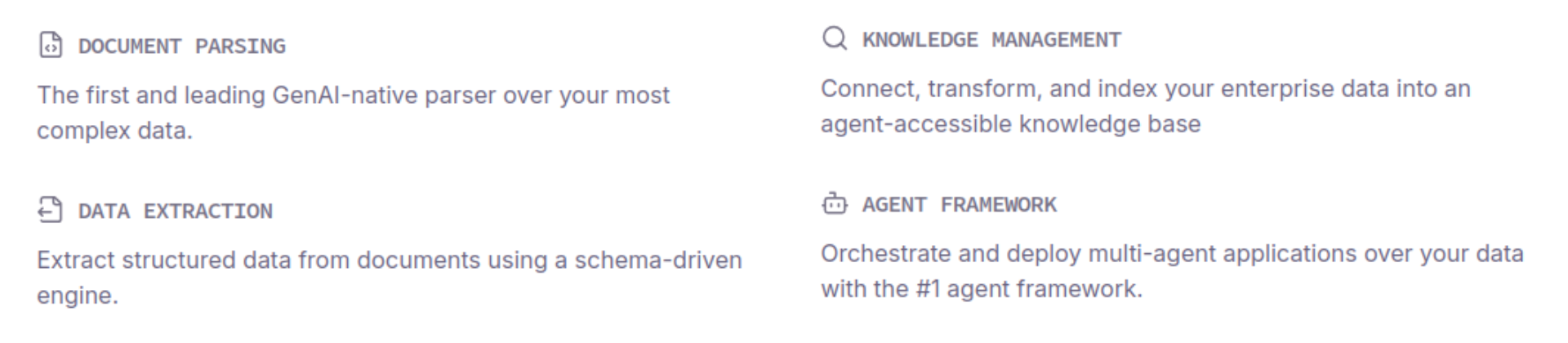
  • LlamaParse: GenAI-native document parsing.
  • LlamaExtract: Schema-driven extraction of structured data.
  • Knowledge Management (KM): Indexing, searching, and governance of knowledge.
  • Agent Framework: Orchestration of multi-step agents with AgentWorkflow.
LlamaIndex products

Business model: open-source + managed LlamaCloud

LlamaIndex offers a dual approach: a very active open-source base (>4M developers), and managed services via LlamaCloud, providing scalability, monitoring, and enterprise support.

How do the components fit together?

Each component can be used alone or combined in a complete pipeline. Example: LlamaParse ingests a PDF, LlamaExtract structures the data, KM indexes everything, and Agent Framework orchestrates an agent that responds to business queries.
👉 For a complete overview of LlamaIndex and its key features, you can refer to our 2025 guide on LlamaIndex.

LlamaParse – GenAI-native Document Parsing

Key features: OCR, tables, skew detection 2025

LlamaParse excels in analyzing complex documents thanks to:
  • Advanced OCR (multilingual optical character recognition)
  • Intelligent table extraction
  • Skew detection (new for 2025): automatic correction of tilted scanned documents
  • New parsing models (May 2025), optimized for accuracy across various formats

Supported formats (PDF, DOCX, PPTX, images)

LlamaParse natively handles:
  • PDF (text and scanned)
  • DOCX, PPTX
  • Images (JPEG, PNG, TIFF)
  • Multi-page and mixed documents

Architecture: parsing → chunking → embedding

The LlamaParse pipeline:
  1. Parsing: raw content extraction
  2. Chunking: intelligent segmentation (pages, sections, tables)
  3. Embedding: vectorization for semantic search

Use cases & best practices

  • Legal contracts: reliable extraction of clauses
  • Invoices: OCR + table parsing
  • Financial reports: managing complex layouts
Best practices: validate the quality of parsing on a sample, adjust chunking parameters according to the document type.

Announced roadmap

  • Support for CAD formats and emails (Q3 2025)
  • Improvement of multilingual parsing
  • User feedback API to refine models
👉 To get started with LlamaIndex in Python, check out our essential tutorial

LlamaExtract – Structured Data Extraction

Schema-driven engine: YAML → JSON/SQL

LlamaExtract allows you to define extraction schemas in YAML, automatically generating structured outputs (JSON, SQL-ready). Ideal for transforming unstructured documents into usable databases.

Creation, testing, and versioning of schemas

  • UI/CLI for creating and testing schemas
  • Native versioning to track the evolution of extraction models
  • Automatic validation of outputs

Current limitations of the beta and costs

  • Limited to 1000 extractions/day in public beta (May 2025)
  • Cost per extraction on LlamaCloud, with volume packages
  • Support for nested schemas is being improved

Business examples: finance, supply chain, compliance

  • Finance: automatic extraction of KPIs in balance sheets
  • Supply chain: structuring delivery notes
  • Compliance: extraction of legal mentions in contracts

Knowledge Management (KM) – Indexing & Search

ETL pipeline: connectors, transformations, indexes

KM offers a complete ETL pipeline:
  • Connectors: SQL, NoSQL, APIs, S3, SharePoint, etc.
  • Transformations: cleaning, enrichment, metadata mapping
  • Indexing: creating indexes optimized for search

Index types: Vector, Keyword, Hybrid, Composable

  • Vector: semantic search (embeddings)
  • Keyword: exact search (full-text)
  • Hybrid: combination of both
  • Composable: multi-source and multi-format indexes

Incremental refresh, monitoring & governance

  • Incremental ingestion (new for 2025)
  • Monitoring: indexing dashboards, error alerting
  • Governance: access management, query auditing

Integration with RAG and AutoRAG

KM natively feeds RAG pipelines, with AutoRAG support for automatic optimization of prompts and context retrieval.

Agent Framework – Multi-Agent Orchestration

AgentWorkflow Architecture: Agent, Tool, Memory, State

The new AgentWorkflow structures agents around:
  • Agent: business logic
  • Tool: access to APIs, databases, external functions
  • Memory: management of conversational context
  • State: tracking the state of the workflow

Agent patterns: Simple QA, Planner-Executor, Workflow

  • Simple QA: question/answer based on documentation
  • Planner-Executor: decomposition and execution of complex tasks
  • Workflow: multi-step orchestrations (e.g., HR onboarding)

Production deployment: Docker, FastAPI, LlamaCloud

  • Docker for containerization
  • FastAPI for exposing REST endpoints
  • LlamaCloud for scalability and monitoring

LLM Compatibility: OpenAI, Anthropic, Mistral, local Llama 3

Native support for major LLMs on the market, including open-source and on-premise deployed models.
Vous souhaitez aller plus loin ? Formez-vous à l’IA Générative et apprenez à maîtriser les bases de l’intelligence artificielle générative.

How to choose (or combine) the components?

Decision matrix by need (parse, extract, KM, agent)

Business need LlamaIndex component to activate
Document ingestion LlamaParse
Data structuring LlamaExtract
Search/Indexing Knowledge Management
Agent automation Agent Framework

End-to-end scenarios: from raw data to operational agent

Example: A consulting firm wants to automate contract analysis:
  1. LlamaParse ingests and cleans PDFs
  2. LlamaExtract extracts key clauses
  3. KM indexes the data for search
  4. Agent Framework deploys an agent that responds to legal questions

Strengths and limitations of a modular approach

Strengths: flexibility, connectors, community of 4M + devs

  • Flexibility: gradual adoption, tailored integration
  • Rich ecosystem: numerous connectors, plugins, integrations
  • Community: support, feedback, contributions

Points of caution: GPU overhead, monitoring maturity, security

  • Costs: intensive parsing/extraction may generate GPU overhead
  • Monitoring: still improvable on some complex workflows
  • Security: attention to access rights management and data confidentiality

Conclusion & resources

Quick implementation checklist

  • Identify needs (parse, extract, KM, agent)
  • Prototype each component on a pilot dataset
  • Monitor costs and performance
  • Involve business users to validate outputs
  • Go into production via LlamaCloud or on-premise

Official documentation, starter templates

If you are still unsure or need specific support, our team is here to help

Want to go further?

This topic is part of our Generative AI for Developers course. Browse the full programme, or get it by email.

Share with

Photo de Romain DE LA SOUCHÈRE

Romain DE LA SOUCHÈRE

Tech Lead, CTO AXI Technologies

Expert Data Engineering et Cloud, Romain affiche plus de 11 ans d'expérience, dont plusieurs années comme Lead Developer sur des solutions Smart Building haute performance. Il y a conçu et mis en production des moteurs de traitement capables d'absorber des centaines de milliers de données de capteurs par minute, ainsi que des bases clusterisées gérant plus de 10 millions de données dynamiques. Certifié Microsoft Azure DevOps Engineer Expert, il maîtrise aussi bien le développement back-end (Python, C#) que le DevOps (Docker, Kubernetes, Terraform) et les agents LLM. Formateur en Python, cloud, DevOps et IA générative appliquée, il forme avec une obsession : Amener chaque apprenant à concevoir et déployer des architectures réellement scalables en production.


» Learn More

Associated trainings

All our trainings
Image de la formation Generative AI for Developers
Generative AI for Developers
50 hours
Intermediate
Guarantee