The Ultimate Guide to REST Paradigm: Principles and Practical Applications
In the realm of web development, REST (Representational State Transfer) architecture has become an essential standard for API design. Whether you are a beginner or an experienced developer, understanding the principles of the REST paradigm is crucial for creating robust, scalable, and maintainable web systems. This guide aims to provide you with an in-depth understanding of the foundations of REST, along with practical examples to illustrate its application in real-world contexts.
Why REST?
REST stands out for its simplicity and efficiency. Unlike other more complex architectures, REST relies on a well-defined set of constraints that facilitate communication between systems. By adopting REST, developers can design APIs that are not only easy to use but also to integrate and extend.
Objectives of this guide
In this article, we will cover the key concepts of REST, such as client-server separation, statelessness, and communication via HTTP. We will also provide concrete examples of REST requests and responses to help you better understand how to implement these principles in your projects. Finally, we will discuss best practices for designing RESTful APIs and common challenges encountered during their implementation.
Get ready to dive into the fascinating world of REST and discover how this architecture can transform the way you develop and interact with web services.
Client-server separation principle
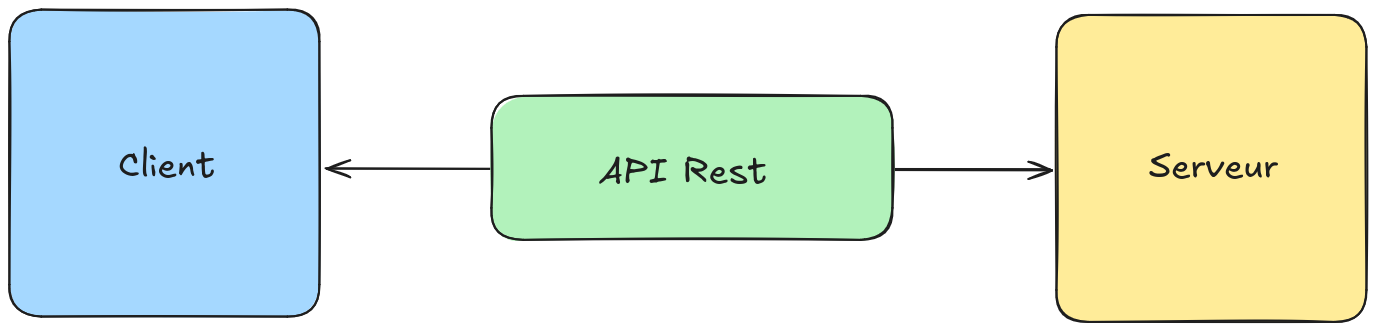
One of the fundamental principles of REST architecture is the clear separation between client and server. This separation allows for total independence between the two parties, thus facilitating the scalability and maintenance of applications.
Advantages of separation
Client-server separation offers several major advantages:
- Development independence: Development teams can work on the client and server independently, which accelerates the development cycle.
- Scalability: Servers can be scaled independently of clients, allowing for increased load management without affecting user experience.
- Flexibility: Clients can be updated or replaced without requiring changes to the server, and vice versa.
- Security: By isolating the client from the server, it is easier to protect sensitive data and secure communications.
Practical example
Let's imagine a task management application. The client, which can be a web or mobile application, sends HTTP requests to the server to create, read, update, or delete tasks. The server, in turn, manages the application logic, interacts with the database, and returns the appropriate responses.
This separation allows the application to remain responsive and scalable while ensuring simplified maintenance and better resource management.
Understanding statelessness
Statelessness is another crucial pillar of REST architecture. This principle states that each request sent by the client to the server must contain all the necessary information to understand and process the request. The server should not retain information about the client's state between requests.
Advantages of statelessness
Statelessness presents several significant advantages:
- Simplicity: The server is simplified as it does not need to manage the client's state. Each request is independent, making management and debugging easier.
- Scalability: Servers can handle a large number of simultaneous requests without being overwhelmed by maintaining client state.
- Reliability: If a server fails, another can take over without data loss, as the state is not stored on the server.
Practical example
Consider a user session management API. Instead of storing the session state on the server, each client request includes an authentication token.
In this example, the server does not need to remember the user between requests. The authentication token included in each request contains all the necessary information to identify and authenticate the user.
By adopting the principle of statelessness, developers can create more robust and easily scalable systems while simplifying server-side logic.
The basics of HTTP communication
Communication between the client and the server in a REST architecture primarily relies on the HTTP protocol. Understanding the basics of this protocol is essential for mastering interactions in RESTful systems.
HTTP methods
HTTP methods define the actions that the client wants to perform on the server's resources. The main methods used in REST are:
- GET: Retrieves a resource from the server.
- POST: Sends data to the server to create a new resource.
- PUT: Updates an existing resource on the server.
- DELETE: Deletes a resource from the server.
HTTP status codes
HTTP status codes are used to indicate the result of requests. They are divided into several categories:
- 200 (OK): The request succeeded.
- 201 (Created): A new resource has been successfully created.
- 400 (Bad Request): The request is malformed or invalid.
- 401 (Unauthorized): Authentication is required and has failed or has not been provided.
- 404 (Not Found): The requested resource could not be found.
- 500 (Internal Server Error): An internal server error occurred.
HTTP headers
HTTP headers provide additional information about the request or response. Some commonly used headers include:
- Content-Type: Indicates the content type of the request or response (e.g.,
application/json). - Authorization: Contains authentication information to access a protected resource.
By mastering these basic elements of HTTP communication, you will be better prepared to design and implement effective and robust RESTful APIs.
Concrete examples of REST requests and responses
To illustrate the principles of REST architecture well, let’s examine some concrete examples of HTTP requests and responses.
Example of resource creation
Let’s imagine we are managing an API to handle users. To create a new user, we would use a POST request.
The server's response might look like this:
Example of resource retrieval
To retrieve the information of a specific user, we would use a GET request.
The server's response could be:
Example of resource updating
To update a user's information, we would use a PUT request.
The server's response would be:
Example of resource deletion
To delete a user, we would use a DELETE request.
And the server's response might be:
These examples show how the various HTTP methods can be used to interact with resources in a RESTful API. By understanding these patterns, you will be better equipped to design and implement your own REST services.
Conclusion
In summary, the REST paradigm is a powerful and flexible architecture that allows for the design of robust and scalable web systems. By adopting the principles of client-server separation and statelessness, you can create APIs that are not only easy to maintain but also highly performant and secure.
Key points recap
- Client-server separation: Allows for total independence between the client and server, facilitating scalability and maintenance.
- Statelessness: Ensures that each request contains all necessary information, simplifying the server and improving scalability.
- HTTP communication: Use of HTTP methods and status codes for clear and efficient interaction between client and server.
- Concrete examples: Practical requests and responses illustrating how to interact with RESTful APIs.
By integrating these principles into your projects, you will be able to create web services that meet your users' needs while being prepared for the future. Remember, designing an effective RESTful API requires a deep understanding of these concepts, as well as a particular attention to best practices and common challenges.
We hope this guide has provided you with the knowledge necessary to start or improve your RESTful projects. Keep exploring and experimenting to fully master this essential architecture in the world of modern web development.